
By Dr. Saad Alshamrani · Last updated October 22, 2026
The gift-giving season is about to start, and this year it begins with higher prices. U.S. consumer prices rose 3.7% in the 12 months ending in September, up from 3.4% in August, and gasoline jumped 9.1% in September alone. At the same time, the big shopping-season surveys show that most shoppers still plan to spend about the same or more than last year (80% in Accenture’s survey).
This year-end budget 2026 guide shows you how to set one spending cap, fund it week by week from now until mid-December, and pay for everything with money you already have, with no credit cards, no buy-now-pay-later and no new debt. It also covers where 2026 prices are rising or falling, and how to use AI shopping tools without letting them spend for you.
Quick summary (TL;DR)
- The backdrop: Prices rose 3.7% over the year to September. Energy is up 20.4% and gasoline 34.2%, while groceries rose only 1.8%.
- What shoppers plan: Surveys put average planned spending between $737 and $779 per shopper, and $1,654 per household in Deloitte’s broader measure.
- The plan: Pick one cap you can pay in full, split it into buckets, and fund it with a fixed weekly amount from late October to mid-December.
- Pay as you go: Use cash or debit only. When the money set aside runs out, spending stops.
- Smart moves: Host more at home (eating out is getting pricier faster than groceries), give fewer but better gifts, and buy gift cards safely.
- AI tools: Let them compare prices and find deals, but never let them buy without your approval.
CentHabits is independent and is not affiliated with any retailer, survey firm or app mentioned here. This guide is general education, not personal financial advice, so check current prices and your own situation before you decide. The same steps also work for any gift-giving or family-spending season, such as Eid, weddings or family visits.
What the 2026 shopping-season numbers say
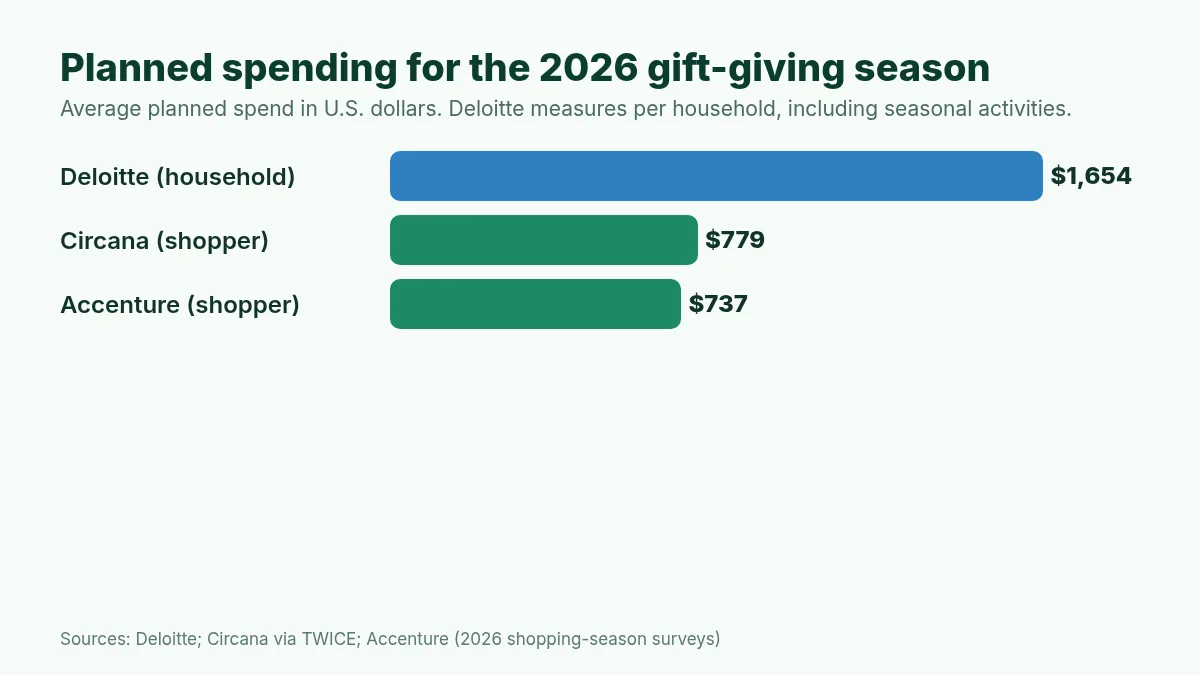
Several major firms published their season forecasts this month. They measure different things, so their averages do not match, but together they paint a clear picture: shoppers are cautious about prices yet still plan to spend.
| Source | What it measured | Average planned spend | Change vs. last year |
|---|---|---|---|
| Deloitte (4,000 consumers, Aug 26–Sep 10) | Per household, retail goods plus seasonal activities | $1,654 | +4% |
| Circana (3,534 consumers) | Per shopper | $779 | Down from $796 |
| Accenture (4,048 U.S. shoppers, Aug 13–Sep 1) | Per shopper | $737 | +12% |
The National Retail Federation (NRF) looks at the retail market as a whole instead. It forecasts that U.S. retail sales in November and December will grow 4.2% to $1.013 trillion. That figure excludes restaurants, gas stations and car dealers.
Three findings stand out for anyone building a budget:
- For many shoppers, prices, not extra gifts, are driving bigger budgets. In Accenture’s survey, 53% of shoppers named rising costs as the main reason their spending this season is growing. Among Circana respondents who expect to spend more, more than half pointed to higher prices. Deloitte found that 79% of respondents expect higher prices ahead.
- Most people are already trying to save. Circana says 74% of consumers expect to adopt money-saving habits, such as buying store brands, hunting for deals and cutting back on extras.
- The season starts early. More than half of Circana’s respondents plan to begin shopping before the big late-November sales, and Deloitte reports that October sales are gaining momentum. A budget set in late October still has time to cover the main shopping weeks.
Why your money feels tighter this season
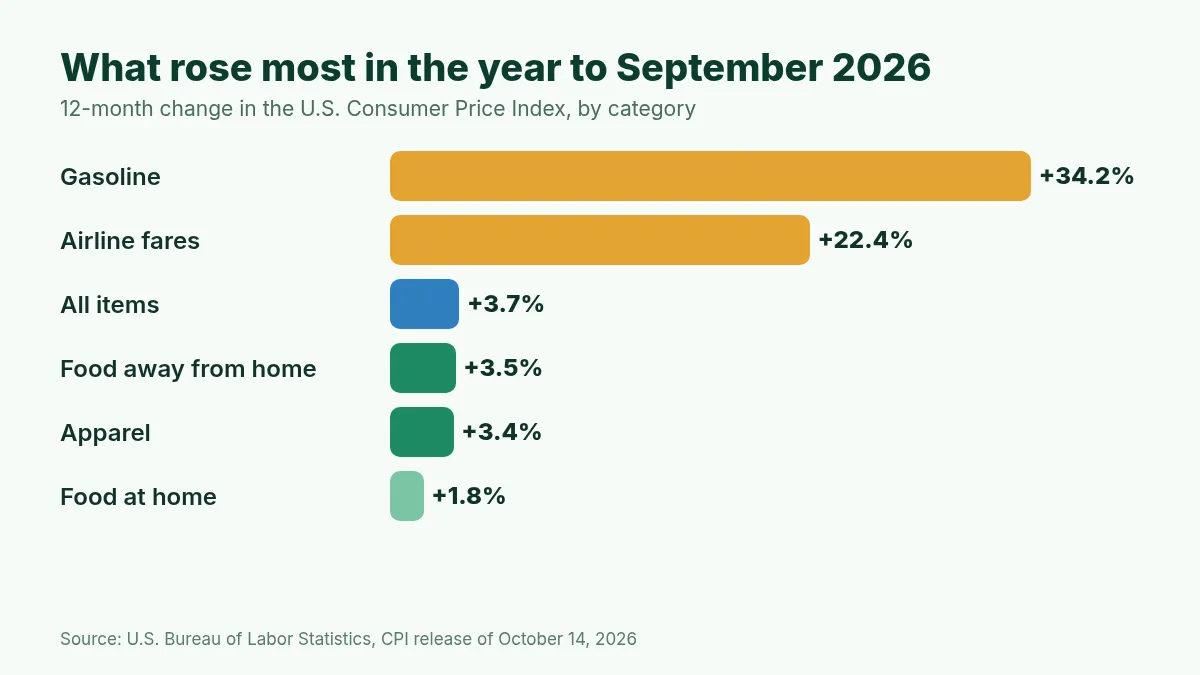
The headline 3.7% hides big differences between categories. Here is what the September Consumer Price Index (CPI) shows for the spending most households do at this time of year.
| Category | Change over 12 months | What it means for your plan |
|---|---|---|
| Gasoline | +34.2% | Driving to visit family costs much more than last year |
| Airline fares | +22.4% | Price any flights early and set a firm travel line |
| Food away from home | +3.5% | Eating out is rising faster than groceries |
| Food at home | +1.8% | Hosting at home stretches your food budget further |
| Apparel | +3.4% | Clothing gifts cost a bit more |
Inside the grocery aisle, the picture is mixed. According to Food Trade News, which reported on the same BLS data, egg prices were 20.6% lower than a year earlier and butter was down 10.3%, while coffee was up 7.1%, apples 7.5% and tomatoes 6.8%. A flexible menu built around what is cheaper this year can save real money.
One more date for your calendar: BLS plans to publish the October CPI on Tuesday, November 10, 2026. It is worth a quick look before your biggest shopping week, in case energy prices move again.
The debt-free year-end budget in 6 steps
The idea is simple: decide the total first, then let every purchase fit inside it. Nothing goes on a credit card or an installment plan, so you can start January without a December bill to pay off.
Step 1: Pick one number you can pay in full
Start with the money you can honestly free up between now and mid-December, without touching rent, utilities, food or your emergency fund. Add any cash you have already set aside for the season. That total is your season cap.
A useful check: compare it with last year’s season spending. If you spent more than you could comfortably afford, set the cap lower this year rather than higher, even though prices have risen.
Step 2: Split the cap into buckets
A single total is easy to overspend. Buckets make the trade-offs visible. Deloitte’s survey hints at a natural split: its average household plans about $988 for retail goods (up 10%) and $666 for seasonal activities (down 4%). You can use whatever split fits your family. Here is an example of a $900 cap (our illustration, not a recommendation for your income):
| Bucket | Share | Amount |
|---|---|---|
| Gifts | 45% | $405 |
| Food and hosting | 25% | $225 |
| Travel and outings | 10% | $90 |
| Giving (charity) | 10% | $90 |
| Personal line (“me”) | 5% | $45 |
| Buffer for surprises | 5% | $45 |
| Total | 100% | $900 |
For gifts, write each person’s name next to a dollar amount. When the names and numbers add up to more than the gift bucket, change the list now, not at the checkout.
Step 3: Fund it weekly, starting now
Divide what you still need by the number of weeks left. In the example, if you already have $300 set aside, you need $600 more. Eight weekly transfers of $75, from the week of October 26 to the week of December 14, cover it. Keep the money in a separate interest-free current (checking) account or a labeled envelope so it does not blend into regular spending.
| Week of | What to do |
|---|---|
| Oct 26 | Set the cap, write the gift list, make the first $75 transfer |
| Nov 2 – Nov 9 | Note the normal price of each item on your list |
| Nov 10 | Glance at the October CPI release |
| Nov 16 | Price any travel and decide: go, shorten, or stay local |
| Nov 23 – Nov 30 | Late-November sales: buy only listed items at or below your target price |
| Dec 7 – Dec 14 | Last two transfers; finish gifts |
| Dec 15 – Dec 31 | Food, hosting and giving only; no new categories |
| Early January | Review what you spent against each bucket |
Step 4: Pay only with money you already have
Use cash or a debit card linked to the money you set aside, with overdraft turned off. It is the simplest way to make the cap real: when the bucket is empty, spending stops.
Step 5: Keep a personal line and a buffer
Buying something for yourself during sales is common, and Deloitte notes that self-gifting is rising, especially among younger shoppers. If you know you will be tempted, give it a small line in the budget instead of pretending it will not happen. Do the same with a buffer for the forgotten gift or the extra guest.
Step 6: Track every purchase in one place
Use a notes app, a spreadsheet or paper. Write the date, the item, the bucket and the amount. Subtract it from the bucket right away. Once a week, look at what is left in each bucket. Moving money between buckets is fine, as long as the total cap never grows.
Smart-spending moves that fit 2026 prices
Host more, eat out less. Prices for food away from home, such as restaurant meals, rose 3.5% over the year, almost twice the 1.8% rise in grocery prices. Circana also sees shoppers moving money toward gatherings at home and convenient prepared foods. A potluck or a simple home meal can often cover a family gathering for less than one restaurant visit.
Plan travel around fuel and fares. With gasoline up 34.2% and airline fares up 22.4% over the year, travel can quietly eat a budget. More than one-third of Circana’s respondents say they are canceling or delaying travel this season because of higher costs. If you do travel, fix the travel bucket first and plan the trip to fit it.
Give fewer, better gifts. In Accenture’s survey, 39% of shoppers said they would rather receive fewer gifts than ones they will not use, and three in five redirected at least one unwanted gift last year. Half of Deloitte’s respondents plan to give an experience; if you do, pick a halal-friendly one. One thoughtful gift often beats three rushed ones.
Buy gift cards safely. Accenture found that 35% of shoppers see gift cards and cash as practical because they reduce the risk of getting a gift wrong. Choose cards only for stores and products that fit a halal budget. The Federal Trade Commission (FTC) advises buying cards only from stores you know and trust, avoiding online auction sites, checking that the protective stickers are intact and the PIN is not showing, and keeping a photo of the card and the receipt. And remember the FTC’s rule: gift cards are for gifts. Anyone who asks you to pay them with a gift card and send the numbers is a scammer.
Use your price list during sales. Because you noted normal prices in early November, you can tell a real deal from a fake one. If an item is not on your list, it waits until January.
Using AI shopping tools without losing control
AI is now part of year-end shopping. Accenture found that four in 10 shoppers will use generative AI for their shopping this season, up from three in 10 last year, mainly for finding deals (39%), comparing options (31%) and identifying the best retailer (30%). Deloitte reports that 39% of respondents use generative AI as their main tool for at least one shopping task, but only 16% would let it complete a purchase.
Accenture also found that shoppers said they would let a personal AI agent spend about $102 on gifts without asking them first. For a debt-free budget, we suggest a stricter rule. Use AI for research, never for buying on its own:
- Ask it to compare prices for one specific item across a few retailers, then check the price on the store’s own page.
- Ask for gift ideas within a set amount, for example: “Five gift ideas under $40 for a 12-year-old who likes science.”
- Ask it to turn your list into a checklist with your bucket totals.
- Keep payment details out of AI tools, and turn off any setting that lets an assistant check out for you.
AI tools can be wrong about prices, stock and shipping times, so treat their answers as a starting point and confirm before you pay.
Common mistakes to avoid
- Setting the cap after shopping starts. By then, the cap tends to follow your cart instead of your cash.
- Forgetting the “invisible” costs. Wrapping, shipping, fuel, hosting and small treats add up. That is what the buffer is for.
- Letting sales change the list. A discount on something you did not plan to buy is still extra spending.
- Borrowing to fill a gap. If the numbers do not fit, cut the list or the cost, not the rule.
- Skipping the January review. Ten minutes of review gives you a better starting number for next year.
Our take
This season’s numbers send a mixed message. Annual inflation is higher than it was a month ago, yet two of the three big surveys show average planned spending going up. That gap is where overspending often starts.
A cap you can pay in full, a weekly transfer and a short list solve most of the problem. You need one number, decided early, that you respect. Start this week, and you will enter January with your gifts given and no December bills waiting.
FAQ
How much should I budget for the year-end shopping season in 2026?
There is no single right number. Surveys put the average at about $737 to $779 per shopper, and $1,654 per household when seasonal activities are included. Your number should come from the cash you can free up without touching essentials or your emergency fund.
Is it too late to start a year-end budget in late October?
No. More than half of Circana’s respondents plan to begin before the big late-November sales, and Deloitte reports that October sales are gaining momentum. Eight weekly transfers from late October still fit before mid-December.
Why avoid credit cards and buy-now-pay-later for year-end shopping?
Cards and installment plans make it easy to spend money you do not have yet. This plan is built on spending only money you already have, so the season ends without debt. When the bucket is empty, spending stops, which is the whole point of a cap.
Are prices higher than last year?
Overall, yes. Consumer prices rose 3.7% over the year to September, led by energy. Groceries rose a more modest 1.8%, and some items such as eggs and butter are cheaper than a year ago.
Can AI tools help me save money on year-end shopping?
Yes, for comparing prices and finding ideas within a budget, as many shoppers plan to do. Confirm prices on the store’s own page and keep the final purchase decision in your hands.
Note: This article is general education, not personal financial, legal or religious advice. CentHabits aims to follow Islamic finance principles, but we are not a fatwa authority, so for a ruling on any specific product or transaction please consult a trusted scholar. See our Disclaimer for details.
Sources
- U.S. Bureau of Labor Statistics — "Consumer Price Index Summary, September 2026," October 14, 2026. https://www.bls.gov/news.release/cpi.nr0.htm
- Food Trade News — "Grocery Prices Dip in September as Energy Costs Threaten New Inflation," October 15, 2026. https://foodtradenews.com/2026/10/15/grocery-prices-dip-in-september-as-energy-costs-threaten-new-inflation/
- Deloitte Insights — "2026 Deloitte Holiday Retail Survey," accessed October 22, 2026. https://www.deloitte.com/us/en/insights/industry/retail-distribution/holiday-retail-sales-consumer-survey.html
- TWICE (TWICE Staff) — "Circana Forecasts Flat To Modest Growth For 2026 Holiday Spending" (report on Circana's 2026 U.S. Holiday Purchase Intentions Study), October 19, 2026. https://www.twice.com/research/circana-forecasts-flat-to-modest-growth-for-2026-holiday-spending
- Accenture — "Holiday shopping 2026: Shoppers are ready to hand AI the gift list," October 16, 2026. https://www.accenture.com/en/insights/consulting/consumer-holiday-research
- National Retail Federation — "NRF Forecasts 2026 Holiday Sales Growth as Consumers Remain Resilient," October 15, 2026. https://nrf.com/media-center/press-releases/nrf-forecasts-2026-holiday-sales-growth-as-consumers-remain-resilient
- Federal Trade Commission, Consumer Advice — "Avoiding and Reporting Gift Card Scams," accessed October 22, 2026. https://consumer.ftc.gov/articles/avoiding-and-reporting-gift-card-scams